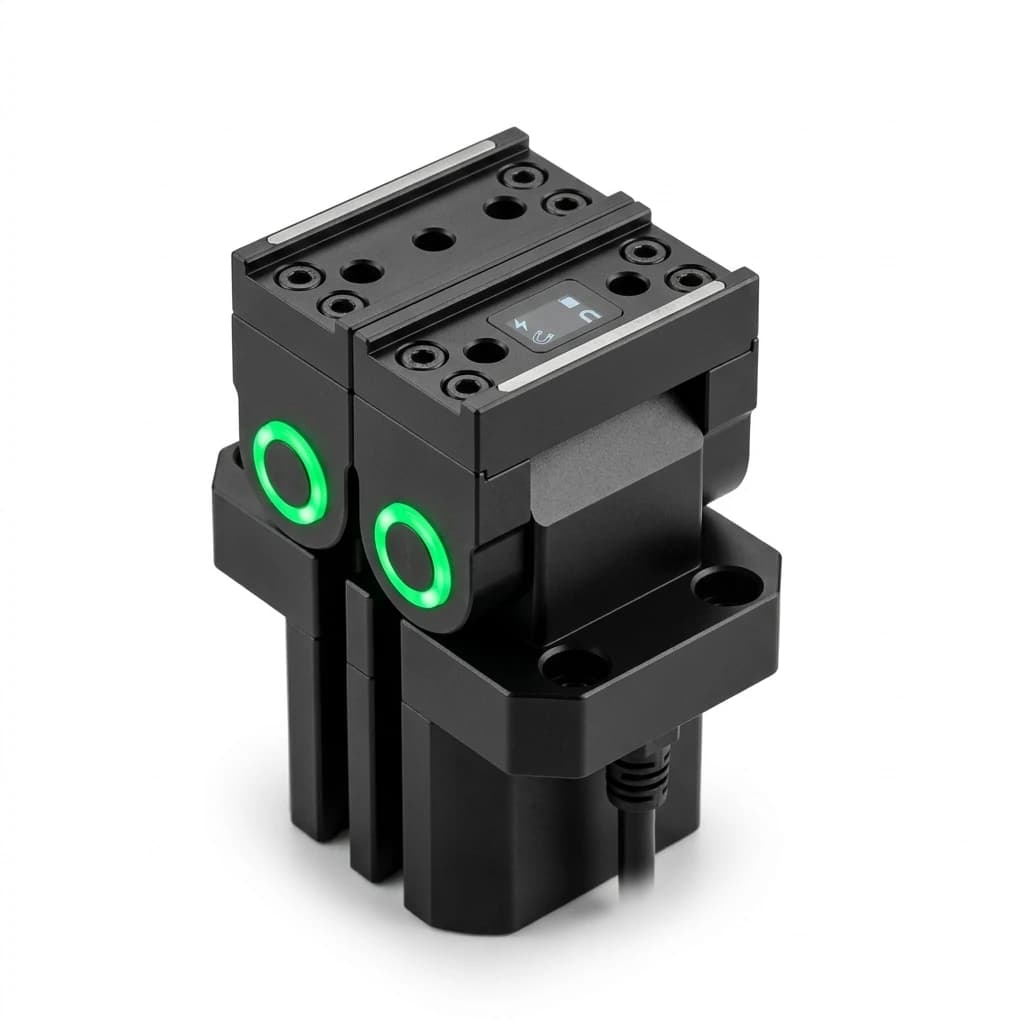
Smart Magnetic Grippers: IO-Link Integration and Procurement TCO
Evaluate smart magnetic grippers with IO-Link for TCO, wiring, diagnostics, and RFQ scope. Use the checklist before choosing standard or smart EPM tooling.
The transition to Industry 4.0 has forced procurement teams and automation engineers to rethink End-of-Arm Tooling (EOAT). As automated cells become more complex, the demand for diagnostic data from the gripper itself has surged.
For ferromagnetic payload handling, Electro-Permanent Magnetic (EPM) grippers have already established themselves as a superior alternative to pneumatic and vacuum systems in terms of energy efficiency and fail-safe safety. However, the latest evolution in this space is the integration of IO-Link.
For a buyer or automation manager, the question is straightforward: Does the premium for an IO-Link-enabled smart magnetic gripper translate into a lower Total Cost of Ownership (TCO)?
This comprehensive guide breaks down the engineering realities, the actual procurement value, and the integration boundaries of IO-Link magnetic grippers for global buyers, distributors, and integrators.
Scope and review date: This guide was reviewed on July 20, 2026 for global industrial buyers, robot integrators, and manufacturing engineers comparing smart EPM grippers against standard 24V I/O magnetic grippers. It applies to ferromagnetic workpieces in robotic EOAT projects. It does not replace a certified lifting calculation, robot risk assessment, IO-Link master compatibility check, or sample validation with production-condition parts.
1. What is an IO-Link Electro-Permanent Magnetic Gripper?
Before evaluating the financial impact, it is crucial to understand the technology boundary.
An Electro-Permanent Magnet (EPM) uses electrical pulses only to change its magnetic state (MAG or DEMAG). During transit, it consumes zero power and holds the workpiece using intrinsic permanent magnets.
Traditionally, an EPM gripper is controlled via standard 24V discrete I/O signals from the PLC or robot controller. It requires specific wires for the MAG command, DEMAG command, and perhaps a basic feedback wire to indicate "operation complete."
IO-Link (IEC 61131-9) is an open-standard, point-to-point communication technology. When integrated into an EPM gripper, the gripper transforms from a "blind" actuator into a "smart" device. Instead of just receiving binary open/close commands, the gripper can transmit rich diagnostic data—such as coil temperature, cycle counts, and magnetic flux anomalies—over a simple, unshielded 3-wire cable.
Wiring Architecture Comparison: Discrete I/O vs IO-Link
2. Standard Discrete I/O vs. IO-Link EPMs: The Core Differences
To evaluate whether the technology is necessary for your specific project, you must look at the exact operational differences.
| Feature / Capability | Standard 24V Discrete I/O EPM | IO-Link Smart EPM | Procurement & Operational Impact |
|---|---|---|---|
| Wiring Complexity | 5 to 8-pin multi-core shielded cables required for power and multiple discrete signals. | Standard unshielded 3-wire or 5-wire M12 cables. | Lower cable costs, faster installation, and significantly reduced risk of wire breakage in high-flex robotic applications. |
| Magnetization Control | Binary (100% ON or 0% OFF). | Variable (e.g., 20% to 100% force adjustable via PLC). | Allows handling of thin steel sheets without picking up multiple layers (double-sheet prevention) without changing hardware. |
| Feedback & Diagnostics | Basic digital feedback (e.g., "Command Received"). | Rich data: Magnetization state, coil temperature, cycle counts, voltage drops. | Predictive maintenance. Prevents unplanned downtime by identifying degrading components before failure. |
| Commissioning Time | Manual testing of I/O pins, hardcoded PLC logic for each specific gripper. | Plug-and-play via IODD (IO Device Description) files. | Faster deployment. When replacing a damaged gripper, parameters are automatically downloaded to the new unit. |
| Fault Isolation | Difficult. A broken wire or failed coil simply results in a "Timeout" error. | Precise. The system reports exactly what failed (e.g., "Coil Overheating" or "Under-voltage"). | Drastically reduces troubleshooting time on the factory floor, improving Overall Equipment Effectiveness (OEE). |
| Hardware Premium | Base cost. | +15% to +30% initial hardware premium. | Higher initial CapEx, but rapidly offset by lower OpEx and reduced downtime in high-volume applications. |
3. Engineering Reality: What Data Do You Actually Get?
Procurement teams often hear buzzwords like "Industry 4.0" and "Predictive Maintenance," but engineers need concrete data points. When you specify an IO-Link magnetic gripper, here is the telemetry you are actually buying:
- Coil Temperature Monitoring: EPM grippers use high-current pulses to switch states. If a robot is programmed with an overly aggressive duty cycle (e.g., switching every 2 seconds without pause), the coils can overheat and fail. An IO-Link gripper monitors its internal temperature and can send a warning to the PLC to slow down the cycle or trigger a cooling pause before catastrophic failure occurs.
- Cycle Counts: The gripper tracks its lifetime actuation cycles. Procurement can schedule preventative maintenance or replacement parts during planned factory shutdowns rather than dealing with emergency overnight shipping.
- Variable Force Calibration: For facilities handling multiple part types (e.g., 2mm sheet metal in the morning, 10mm thick plates in the afternoon), IO-Link allows the PLC to send a dynamic parameter to reduce the magnetic force for the thin sheets, preventing multiple sheets from sticking together.
- Flux Anomaly Detection: Advanced smart grippers can detect if the magnetic circuit has closed properly. If a part has excessive scale, rust, or an air gap, the gripper can flag a "Sub-optimal Holding" warning, prompting the robot to move at a slower speed or reject the part safely.
4. TCO Analysis: Where the Savings Actually Come From
Why would a procurement manager authorize a 20% premium on a gripper? The Total Cost of Ownership (TCO) calculation for IO-Link devices shifts the focus from CapEx to OpEx.
- Reduced Cabling Costs: High-flex robotic cables are expensive. Replacing a proprietary 8-core shielded cable with a standard off-the-shelf 3-wire M12 sensor cable reduces both initial BoM costs and replacement inventory costs.
- Minimized Commissioning Time: Integrators charge by the hour. With IO-Link's IODD files, integrating a new gripper into a Siemens, Rockwell, or Beckhoff PLC takes minutes instead of hours of mapping discrete I/O addresses.
- Zero-Downtime Replacements: In a high-volume automotive stamping plant, every minute of downtime costs thousands of dollars. If a standard gripper is crushed by a robot crash, replacing it requires recalibration and manual parameter entry. With IO-Link's Data Storage feature, the replacement gripper is plugged in, and the IO-Link master automatically pushes the correct configuration to the new device. Production resumes instantly.
5. The Procurement Checklist: When to Specify IO-Link
Do not over-specify. While IO-Link is powerful, it is not strictly necessary for every project. Use this checklist to decide if an IO-Link magnetic gripper is the right choice for your RFQ:
- High Mix / Low Volume Production: Do you handle various steel thicknesses on the same line? (If yes, IO-Link's dynamic force adjustment is highly valuable).
- High Cycle Rates: Does the process require more than 10 picks per minute? (If yes, temperature monitoring via IO-Link prevents coil burnout).
- Continuous Operation Constraints: Is your facility operating 24/7 where unplanned downtime costs >$1,000/hour? (If yes, predictive maintenance data justifies the premium).
- Robot Cable Management: Is routing thick, stiff, multi-core cables down the robot arm causing premature cable wear? (If yes, IO-Link's thin 3-wire cables solve this).
- Existing Infrastructure: Does the cell already use an IO-Link master block for other sensors? (If no, adding a master block just for one gripper may ruin the ROI).
6. Managing Risks and Limitations
Smart magnetic grippers are not immune to physics. While the digital communication is flawless, the physical limitations of magnetism remain:
- Air Gaps Override Smart Features: IO-Link can tell you if the temperature is fine, but if the workpiece is covered in 3mm of grease, the magnetic force will drop dramatically. Digital sensors cannot overcome the inverse-square law of magnetism.
- Residual Magnetism Needs Validation: Even with smart control, specific alloy steels will retain residual magnetism. If the downstream process is TIG/MIG welding, you still need to ensure the gripper is physically capable of deep demagnetization cycles, regardless of the communication protocol.
- Cybersecurity / Network Load: While minor, pushing too much diagnostic data constantly can load industrial networks. Ensure your integrator sets appropriate polling rates for diagnostic data compared to critical process data.
7. Frequently Asked Questions (FAQ)
Q: Does IO-Link make the magnetic gripper hold stronger? A: No. IO-Link is a communication protocol. It does not increase the physical holding force of the Electro-Permanent Magnet. However, it allows you to dynamically adjust the magnetization level and monitor if the holding force drops, preventing dropped parts.
Q: Is an IO-Link master required for every single gripper? A: An IO-Link master module is required on the robot or PLC side, but a single master usually has 4 to 8 ports, meaning you can connect multiple smart grippers or other IO-Link sensors to a single master module.
Q: Can we retrofit existing EPM grippers with IO-Link? A: Generally, no. The IO-Link communication chip and the necessary diagnostic sensors (like temperature monitors and flux sensors) must be integrated into the gripper's internal controller during manufacturing.
Q: What happens to the gripper if IO-Link communication is lost? A: Because it is an Electro-Permanent Magnet (EPM), a loss of communication (or power) does not cause the gripper to drop the part. The internal permanent magnets maintain the holding force indefinitely until a demagnetization command is successfully received and executed.
Q: Are IO-Link cables more expensive than standard gripper cables? A: Actually, IO-Link uses standard, unshielded 3-wire or 5-wire cables (typically M12 connectors), which are widely available and often cheaper and more robust against continuous flexing on a robot arm than proprietary multi-core shielded cables.
8. Next Steps for Buyers and Engineers
If your facility is moving toward data-driven automation, IO-Link magnetic grippers offer a clear path to reducing unplanned downtime and simplifying robotic integration.
When preparing an RFQ for a smart EOAT solution, ensure you provide the supplier with the specific PLC brand, the available IO-Link master ports, and the exact workpiece dimensions to guarantee the magnetic module matches the digital capabilities.
For help evaluating your specific payload, you can consult our sample validation guidelines or contact our engineering team to review whether a standard or smart EPM gripper is the best fit for your application.
Sources and References
- PROFINET News (2025): IO-Link in Robotics: Simple, Small, and Inexpensive. An overview of how IO-Link is replacing complex wiring in robot end-effectors. Read Article
- Schmalz Glossary: IO-Link. Guidelines on standardized point-to-point communication, unshielded three-core cables, IODD files, and remote parameterization for industrial automation. Read Documentation
- Zimmer Group Handling Technology: Insights into the market availability and integration of smart grippers combining holding technology with IO-Link feedback. Explore Catalog
Author

Categories
More Posts
High-Temperature Magnetic Grippers: Sizing and Procurement for Hot Forging
High-temperature magnetic grippers sizing guide for hot forging: compare EPM safety, payload derating, duty cycles, cooling options, and RFQ inputs for buyers.
Magnetic Gripper Residual Magnetism and Demagnetization
Guide for engineers and buyers on why parts stick to magnetic grippers, how active demagnetization works, and how to define release acceptance criteria.
Safety Compliance and Fail-Safe Mechanisms in Magnetic EOAT: ISO 10218-2 and PL Buyer's Guide
A buyer's guide for procurement and engineering teams specifying fail-safe electro-permanent magnetic grippers against ISO 10218-2 and ISO 13849-1 expectations.