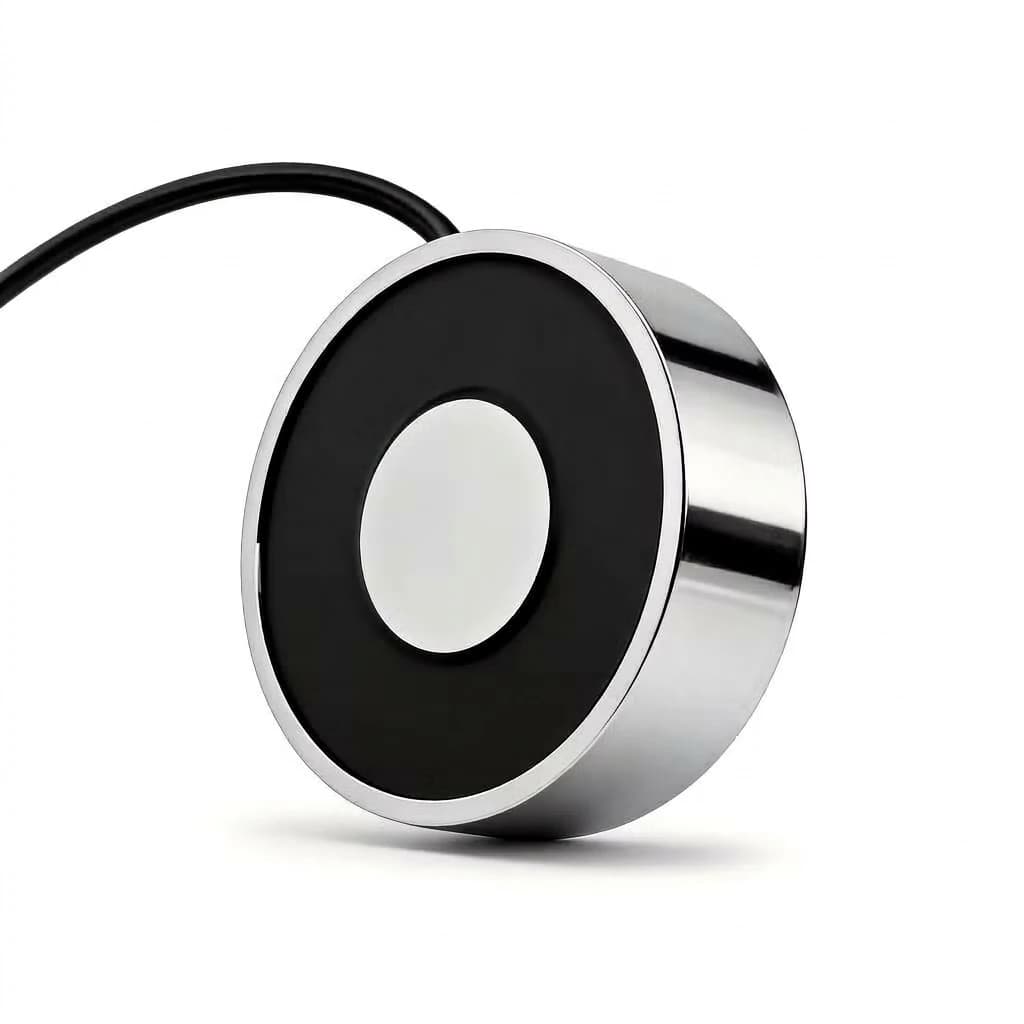
Magnetic Gripper Residual Magnetism and Demagnetization
Guide for engineers and buyers on why parts stick to magnetic grippers, how active demagnetization works, and how to define release acceptance criteria.
When a magnetic gripper successfully lifts a heavy steel workpiece, the process seems robust. However, automation engineers know that lifting the part is only half the job. Releasing the part cleanly—exactly when and where it is needed—is often much more difficult.
The primary culprit behind "sticky" releases and double-sheet feeding is residual magnetism. This guide breaks down why parts retain magnetism, how modern grippers solve it through active demagnetization, and what buyers must include in their RFQs to avoid costly automation failures.
Scope and Limits
This article is written for engineers, procurement teams, and automation integrators handling ferromagnetic steel parts with permanent, pneumatic, or electro-permanent magnetic grippers. It does not apply to aluminum, copper, plastic, most austenitic stainless steels, vacuum tooling, or mechanical finger grippers because those systems do not magnetize the workpiece in the same way.
The gauss limits and release-time examples below are practical starting points for RFQs and sample validation, not universal pass/fail values. Final acceptance should be measured on your real material grade, heat treatment, coating, part geometry, robot speed, and downstream process.
Why Do Workpieces Retain Magnetism?
When a ferromagnetic material is exposed to a strong magnetic field from a gripper, its internal magnetic domains align to create the holding force. When the gripper is switched off or moved away, those domains do not instantly snap back to a random state. A certain amount of alignment remains, turning the workpiece itself into a weak magnet.
The severity of this effect depends entirely on the material properties, specifically its coercivity (its resistance to changes in magnetization).
The table below outlines how different materials behave after a magnetic handling cycle:
| Material Type | Typical Carbon Content | Coercivity / Residual Magnetism Risk | Release Behavior & Engineering Notes |
|---|---|---|---|
| Low-Carbon / Mild Steel (e.g., 1018, A36) | < 0.25% | Low | Drops cleanly in most applications. Passive release is usually sufficient. |
| Medium-Carbon Steel (e.g., 1045) | 0.25% - 0.60% | Moderate | May require a slight physical shock or a weak demagnetizing pulse to drop cleanly. |
| High-Carbon / Tool Steel (e.g., D2, O1) | > 0.60% | High | High risk of sticking. Requires active demagnetization for automated drop-off. |
| Cast Iron | 2% - 4% | Moderate to High | Often retains magnetism and attracts abrasive metal chips in machining centers. |
| Hardened Steel Parts | Varies (Heat Treated) | Very High | Heat treatment increases coercivity. Will not release without a strong AC demagnetization pulse. |
| Martensitic Stainless (e.g., 400 series) | Varies | Moderate to High | Magnetic, but prone to retaining a field. Test before finalizing gripper choice. |
The Impact of Residual Magnetism on Automation
Ignoring residual magnetism during the tooling selection phase leads to predictable failures on the factory floor:
- Inaccurate Placement: If a part sticks slightly to one side of the gripper during release, it will swing or drop unpredictably, violating placement tolerances in assembly cells.
- Chip Accumulation: In CNC machine tending, a magnetized part will attract metal shavings. If these shavings remain on the part, they can ruin the seating in the next fixture or damage cutting tools.
- Welding Arc Blow: Welding guidance from TWI notes that residual magnetic fields can deflect the welding arc. In production this can cause spatter, incomplete fusion, and failed quality inspections.
- Double Sheet Clinging: In press brake and stamping automation, residual magnetism can cause stacked sheets to cling together, leading to double-feeding and severe die damage.
Passive Release vs. Active Demagnetization
To solve these issues, the industry uses different approaches based on the gripper technology.
Passive Release (Pneumatic Magnetic Grippers)
Pneumatic magnetic grippers move a permanent magnet away from the contact face inside the housing. This removes the primary magnetic field. However, it does nothing to remove the residual magnetism left in the part. If the part is high-carbon steel, it may still cling to the steel pole face of the gripper.
Active Demagnetization (Electro-Permanent Magnetic Grippers)
Electro-Permanent Magnetic (EPM) grippers, such as SCHUNK EMH units and demagnetization systems from Goudsmit Magnetics, use a much more sophisticated approach.
During the release phase, the EPM controller does not simply cut the power. Instead, it sends a rapidly alternating, decaying current (an AC pulse) through the internal coils. This creates an alternating magnetic field that forces the magnetic domains in the workpiece to flip back and forth, gradually reducing their alignment to near zero.
This active demagnetization guarantees a "clean drop" even for difficult, hardened components, making EPM technology the standard for high-reliability robotics.
RFQ Checklist: Defining Release Acceptance Criteria
When buying a magnetic gripper, do not accept quotes that only specify "holding force." You must define what a successful release looks like in your specific environment.
Use this checklist when drafting your RFQ for a magnetic EOAT or cobot magnetic gripper:
- Specify Material Grade and Condition: List the exact carbon content or steel grade (e.g., 1045, D2 tool steel) and state if the part is heat-treated or hardened.
- Define the Post-Process: Explicitly state if the part goes directly to a TIG/MIG welding station or a high-precision CNC fixture where chips are a hazard.
- Set a Maximum Release Time: Define how quickly the part must drop after the "release" signal is sent (e.g., "Part must fully detach within 0.5 seconds").
- Establish Placement Tolerance: If the part swings due to sticking, it fails. State the acceptable drop zone (e.g., "Must drop within a ±1 mm tolerance window").
- Require Active Demagnetization Validation: If you are purchasing an EPM gripper, require the supplier to demonstrate the active demagnetization pulse on a representative sample of your material.
- Check Controller Integration: Ensure the demagnetization pulse time and intensity can be adjusted via the robot's PLC (e.g., via IO-Link or digital I/O).
How to Measure Residual Magnetism Before Tooling Approval
When discussing "clean release," subjective terms like "a little sticky" are not engineering standards. To avoid disputes between procurement, automation integrators, and magnetic gripper suppliers, the industry relies on quantitative measurements of magnetic flux density.
If residual magnetism is a known risk for your parts (e.g., you are handling D2 tool steel or high-carbon automotive stampings), include a measurement procedure in your project validation plan.
Using a Gauss Meter (Tesla Meter)
The most common way to measure residual magnetism is with a handheld Gauss meter equipped with a Hall effect probe.
- Baseline Measurement: Before the workpiece is ever picked up by a magnetic gripper, measure its surface with the Gauss meter. Record the baseline magnetic field in Gauss (G) or milliTesla (mT). For reference, the Earth's magnetic field is roughly 0.5 G.
- Post-Release Measurement: After the gripper picks up the part and actively demagnetizes it, wait for the part to drop, then immediately measure the exact contact zone again.
- Acceptance Threshold: Define a maximum allowable residual field. For standard machining, many teams start the discussion around 10-20 G and then tighten or relax the threshold after a fixture trial. For TIG/MIG welding, TWI warns that magnetic arc blow can become a risk at higher residual fields, so weld-bound parts should be validated with the actual process instead of relying on a generic number. For bearing manufacturing or electronics handling, the threshold is usually project-specific and may need to be in the single-digit gauss range.
The Paper Clip Test (Quick Factory Floor Check)
If a Gauss meter is not available during a preliminary try-out, the "paper clip test" is a universally recognized heuristic:
- If a standard steel paper clip will not adhere to the workpiece after release, the residual magnetism is typically under 15-20 G.
- If metal dust from grinding or fine steel wool clings to the surface like a "beard," the magnetism is too high for precision operations.
- Treat this as a screening check only; supplier approval should still use a Gauss meter and a written acceptance threshold.
By establishing these measurement baselines during the sample validation phase, buyers can objectively accept or reject a supplier's EPM controller tuning.
Conclusion and Next Steps
Residual magnetism is not an unsolvable physics problem; it is a predictable engineering variable. By understanding your workpiece's coercivity and specifying active demagnetization technology, you eliminate one of the most common causes of automation downtime.
If your current pneumatic or permanent magnetic grippers are causing placement errors or attracting debris, it is time to evaluate an Electro-Permanent Magnetic solution.
Before committing to tooling, test your actual workpieces. Contact our engineering team at [email protected] or message us on WhatsApp at +86 18857971991 to schedule a validation loop for your specific steel grade. We will prove the release behavior before you buy.
Frequently Asked Questions (FAQ)
What is the difference between coercivity and retentivity in this context?
Retentivity is the amount of magnetism a material can hold after the external field is removed. Coercivity is the amount of reverse magnetic energy required to remove that retained magnetism. High-carbon steels have both high retentivity (they become strong magnets) and high coercivity (they are hard to demagnetize). This combination is what makes them difficult for standard magnetic grippers to release.
Does the thickness of the steel part affect residual magnetism?
Yes, but indirectly. Thin sheets are easily saturated by a magnetic field, meaning the entire volume of the material is magnetized. If multiple thin sheets are stacked, the field lines pass through all of them. When the gripper releases, the residual magnetism between the sheets acts as a weak glue, causing them to stick together. For thin sheets, using a gripper with "shallow" magnetic field penetration is just as important as the demagnetization pulse.
Can I just use a stronger air blow-off to force the part to drop?
Mechanical strippers, ejector pins, and pneumatic blow-offs are common "band-aids" for residual magnetism. However, forcing the part off the gripper introduces mechanical wear, requires complex compressed air plumbing, and does not solve the root problem: the part is still magnetized. A magnetized part will go on to attract metal chips in the next CNC operation or cause defects in the next welding station. Active demagnetization solves the root cause.
Do vacuum grippers ever suffer from residual magnetism?
No, vacuum grippers use negative air pressure, so they do not magnetize parts. If residual magnetism is an absolute showstopper and active demagnetization EPM grippers still cannot meet the required < 2 G threshold for a specific exotic alloy, vacuum or mechanical finger gripping may be the only viable engineering alternatives. However, magnetic grippers are still preferred when parts are heavily oiled, perforated, or extremely hot.
Sources
Author

Categories
More Posts
High-Temperature Magnetic Grippers: Sizing and Procurement for Hot Forging
High-temperature magnetic grippers sizing guide for hot forging: compare EPM safety, payload derating, duty cycles, cooling options, and RFQ inputs for buyers.
Safety Compliance and Fail-Safe Mechanisms in Magnetic EOAT: ISO 10218-2 and PL Buyer's Guide
A buyer's guide for procurement and engineering teams specifying fail-safe electro-permanent magnetic grippers against ISO 10218-2 and ISO 13849-1 expectations.
Smart Magnetic Grippers: IO-Link Integration and Procurement TCO
Evaluate smart magnetic grippers with IO-Link for TCO, wiring, diagnostics, and RFQ scope. Use the checklist before choosing standard or smart EPM tooling.