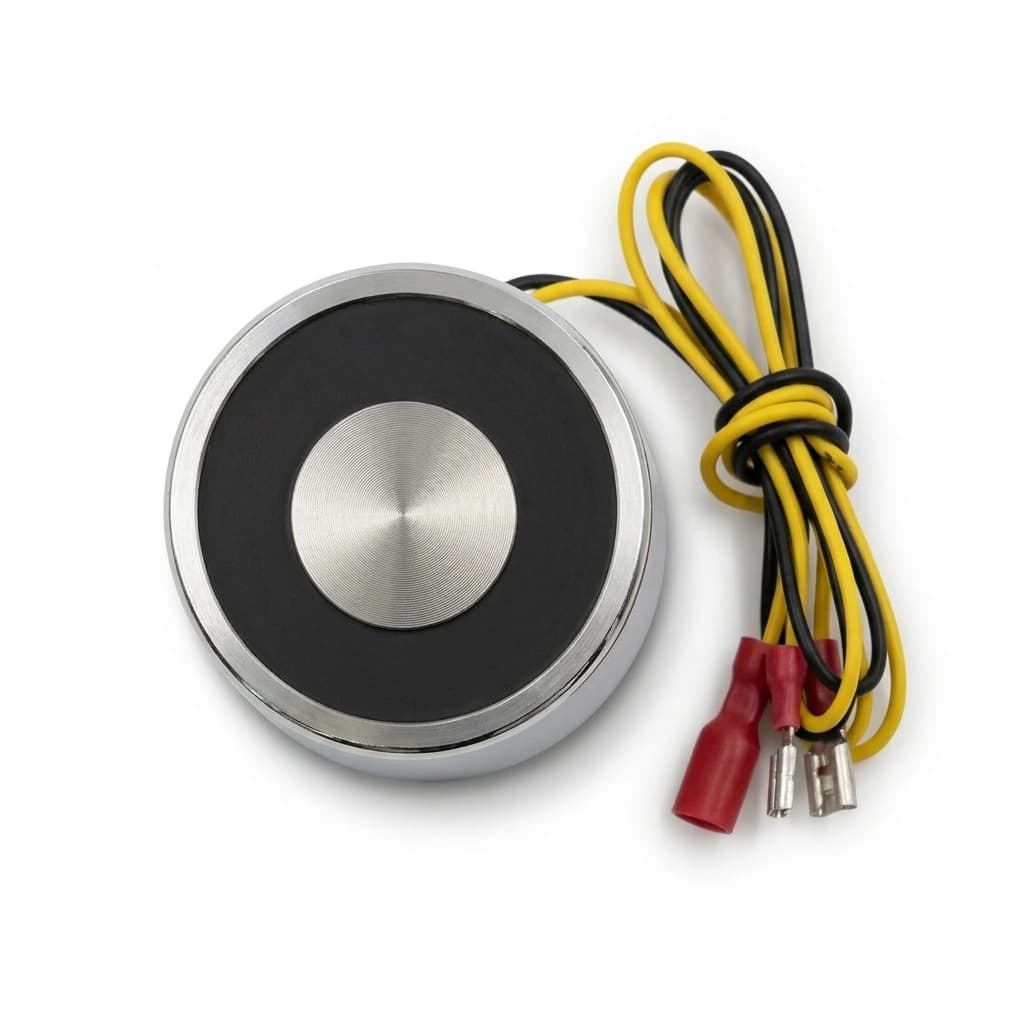
Electro-Permanent Magnetic Gripper RFQ Checklist
Prepare an electro-permanent magnetic gripper RFQ with the workpiece data, holding-force assumptions, controls, and validation criteria suppliers need.
An electro-permanent magnetic gripper RFQ should not be a short message asking for "holding force and price." That starts a slow back-and-forth because the supplier cannot size the magnetic circuit, controller, cable, pole layout, or release behavior without workpiece and process data.
Use this checklist before sending a robot handling, sheet metal transfer, machine tending, or custom magnetic EOAT inquiry.
Why Electro-Permanent Magnetic Grippers Are Different
An electro-permanent magnetic gripper uses a switching pulse to magnetize or demagnetize the magnetic circuit. In many handling cells, it can hold after switching instead of drawing continuous power like a conventional electromagnet.
That benefit does not remove the need for validation. Holding force still depends on the real workpiece: material, thickness, contact area, air gap, surface condition, motion, and release requirements.
Start with the electro-permanent magnetic gripper product page for the product family, then use this page to prepare the RFQ details.
The buyer should validate the switching sequence, hold state, release behavior, and recovery assumptions instead of asking only for a force number.
Where Electro-Permanent Gripping Is Usually a Good Fit
Review electro-permanent gripping when the part is ferromagnetic, the cell needs low-energy holding after switching, and the buyer wants a compact magnetic module instead of a larger pneumatic or mechanical mechanism.
Typical RFQs involve sheet metal transfer, robotic pick-and-place, machine tending, palletizing/depalletizing, and custom EOAT where continuous power draw or heat from a conventional electromagnet is undesirable.
It is not automatically the best choice when release must be extremely fast and residue-free, when the part is non-magnetic, when the part surface varies heavily, or when the safety strategy requires active sensing and mechanical capture through every motion.
Electro-Permanent vs Electromagnetic vs Permanent Magnet
| Option | Strength | Limitation | Typical buyer question |
|---|---|---|---|
| Electro-permanent magnetic gripper | Can hold after switching in many designs; good for low-energy hold | Needs controller, switching logic, and release validation | Can it meet our release timing and safety model? |
| Electromagnetic gripper | Simple active on/off logic in many applications | Continuous power and heat may matter | Is continuous power acceptable for the duty cycle? |
| Permanent magnet tooling | Simple and robust where manual or mechanical release is acceptable | Release and automation control can be harder | Can the process tolerate manual or mechanical release? |
Treat this comparison as a first filter. The final decision still depends on workpiece material, air gap, motion, cycle time, safety policy, and integration details.
The Minimum RFQ Data Set
Send these items before asking for a final selection:
| RFQ item | What to send | Why it matters |
|---|---|---|
| Material | Steel grade, magnetic response, coating, and heat treatment if known | Magnetic permeability changes holding behavior. |
| Dimensions | Length, width, thickness, holes, bends, and pickup zone | Pole layout needs real contact geometry. |
| Weight | Actual part weight and expected tolerance | Sizing needs load and safety margin. |
| Surface condition | Oil, scale, burrs, paint, galvanizing, and roughness | Air gap can reduce holding force sharply. |
| Motion profile | Pickup orientation, acceleration, rotation, travel path, and emergency stop assumptions | Dynamic loads can exceed static estimates. |
| Release need | Release time, placement tolerance, residual magnetism sensitivity | Demagnetization and cycle timing need validation. |
| Robot interface | Robot model, flange, payload, tool I/O, voltage, and cable route | Mechanical and electrical integration are part of the gripper. |
| Quantity and schedule | Prototype quantity, annual demand, destination, and target delivery date | Affects sample plan, production planning, and packaging. |
Holding Force Should Be Reviewed as a System
Do not treat holding force as a single catalog number. Catalog values are measured under controlled conditions. Your project may have coating, oil, poor flatness, or only partial pole contact.
For a review that matches the line, define:
- Required holding margin or internal safety factor.
- Pickup orientation and worst-case motion.
- Whether the part may peel, slide, rotate, or swing.
- Any safety standard, guarding rule, or drop-prevention requirement.
- Whether stacked parts may be lifted together.
If the application is sheet metal or blank transfer, pair this with sheet metal handling. If the gripper is part of a robot cell, also review robot pick-and-place.
Holding-Force Assumptions to Challenge
Before accepting a quote, ask what assumptions were used. A quotation should not only state a force number; it should explain the condition behind that number.
Check whether the supplier assumed:
- Clean, flat, thick steel or the real production surface.
- Full pole contact or partial contact.
- Horizontal lift only or vertical/rotating motion.
- Static holding or dynamic acceleration.
- Single-part pickup or stacked/nested parts.
- A specific air gap caused by coating, oil, burrs, or scale.
If the assumptions do not match the actual line, request sample validation or a revised sizing review.
Power-Loss and Safety Review Questions
Electro-permanent magnetic gripping is attractive partly because many designs can hold after switching. That does not replace a safety review. The buyer, integrator, and supplier should clarify what happens during normal operation, power loss, emergency stop, maintenance mode, and manual recovery.
Ask these questions early:
| Scenario | Question to answer |
|---|---|
| Power loss | Does the part remain held, release, or require a controlled recovery step? |
| Emergency stop | What motion state is assumed, and can the part slide, peel, or swing? |
| Manual recovery | How does an operator safely release or remove the workpiece? |
| Controller fault | Does the cell detect switching failure or require external confirmation? |
| Maintenance mode | Can technicians test pickup and release without running the robot path? |
| Guarding policy | Does the customer's safety standard require mechanical support, sensing, or process interlock? |
These are system-level questions, not only gripper questions. The gripper supplier can help define assumptions, but the final safety strategy belongs to the cell integrator and end user.
Control and Cable Questions to Answer Early
Controls are often specified too late. For electro-permanent grippers, clarify:
- Available voltage and signal type.
- Whether the controller is mounted on the EOAT, robot arm, panel, or machine frame.
- Cable length, bending path, and connector preference.
- Whether pickup/release confirmation is required.
- Whether the cell needs manual override or maintenance-mode behavior.
- Whether multiple magnetic modules switch together or independently.
The control cable connector customization page is the right internal link for these details.
Sample Validation Plan
Before batch production, define the validation plan:
- Test at least three representative parts if part variation is expected.
- Measure pickup reliability across the real contact surface.
- Test release timing and residual magnetism.
- Run the robot path at expected acceleration and orientation.
- Check stacked-part behavior if the cell picks from piles or pallets.
- Record acceptance criteria before revising the design.
Use the sample validation quality control page to align pass/fail thresholds and revision control.
Suggested Acceptance Criteria
Define acceptance criteria before the first sample is built:
| Test | What to record |
|---|---|
| Pickup reliability | Number of consecutive successful pickups at expected orientation and cycle speed |
| Dynamic motion | Whether the part slides, peels, swings, or rotates during acceleration and stopping |
| Release timing | Time from release signal to stable part placement |
| Residual magnetism | Whether the part sticks, drags, attracts chips, or affects the next process |
| Stacked part behavior | Whether a second blank or nested part is unintentionally lifted |
| Heat and duty cycle | Whether controller and module behavior remains stable across the expected shift pattern |
| Integration fit | Cable route, connector access, mounting clearance, and maintenance access |
Not every project needs every test, but the high-risk tests should be agreed before production tooling.
Supplier Questions Worth Asking
Ask these questions before committing:
- What workpiece assumptions were used for holding-force sizing?
- Which air gap or surface condition limits the design?
- What inputs are still missing before final selection?
- What sample validation is recommended?
- What is included in the quotation: gripper only, controller, adapter, cable, connector, packaging, and documents?
- What should be frozen before batch production?
These questions help procurement compare offers on engineering substance, not only price.
What a Better Quote Should Include
A quote for an electro-permanent magnetic gripper should include more than the unit price. Ask for:
- Recommended magnetic module or EOAT concept.
- Assumed workpiece data and holding-force basis.
- Controller, cable, connector, and signal assumptions.
- Mounting interface or adapter plate scope.
- Expected sample validation plan and pass/fail items.
- Items excluded from the quote, such as robot-side brackets, sensors, or special packaging.
- Prototype lead time, batch lead time, and revision process after sample feedback.
This puts engineering and procurement on the same comparison basis.
Supplier Comparison Scorecard
When procurement receives several quotes, compare them on engineering completeness before comparing price.
| Score area | Strong quote | Weak quote |
|---|---|---|
| Workpiece assumptions | Lists material, thickness, contact area, air gap, and motion assumptions | Shows only a generic force number |
| Integration scope | Defines module, controller, cable, connector, mounting, and exclusions | Does not state what is included |
| Validation plan | Proposes sample tests and pass/fail criteria | Says "should work" without test plan |
| Revision handling | Explains what happens after sample feedback | No clear path for pole layout or mounting changes |
| Documentation | Provides wiring note, drawing, inspection record, and export package if needed | Only provides invoice-level details |
| Lead time | Separates prototype, test revision, and batch schedule | Gives one delivery date without assumptions |
This scorecard prevents a low first price from hiding missing engineering work.
Prototype-to-Batch Review Flow
A workable project flow looks like this:
- Application review: buyer sends workpiece data, photos, robot interface, motion notes, and target quantity.
- Concept proposal: supplier recommends magnetic circuit, pole layout, controller, cable, and mounting concept.
- Prototype quote: scope includes what will be built, what is excluded, and what test assumptions are used.
- Sample validation: buyer or supplier tests pickup, release, motion, surface variation, and stacked-part behavior.
- Revision decision: pole layout, adapter plate, cable exit, connector, or controller settings are revised if needed.
- Batch freeze: drawing, inspection record, packaging, label, and documentation requirements are frozen.
- Production and export: batch is produced with agreed acceptance criteria and shipping documents.
Skipping validation and revision can make the first batch cheaper on paper but more expensive on the production line.
A structured validation loop turns sample findings into engineering revisions before production tooling is frozen.
Example RFQ Message
We need an electro-permanent magnetic gripper for robot handling.
Part: [material/grade], [thickness], [dimensions], [weight], surface [oil/coating/burrs].
Motion: pickup [horizontal/vertical/tilted], cycle [seconds], acceleration or robot path notes attached.
Release: required placement tolerance [mm], residual magnetism concern [yes/no].
Robot/interface: [brand/model], flange, payload, available I/O, voltage, cable route.
Quantity: prototype [quantity], expected annual demand [quantity], destination [country].
Please quote module/controller/cable scope and recommended sample validation.
Practical CTA
For a first review, email [email protected] with drawings, part photos, material, thickness, weight, robot model, pickup orientation, and target quantity. You can also send the same package by WhatsApp to +86 18857971991.
Buyer-Side Pre-RFQ Worksheet
Copy this worksheet into an internal ticket before contacting suppliers:
| Field | Buyer input |
|---|---|
| Main objective | Replace existing gripper, new automation cell, reduce air use, reduce misses, or custom OEM build |
| Workpiece family | Part numbers, material grades, thickness range, weight range, and surface conditions |
| Worst-case part | The sample most likely to fail because of air gap, coating, thinness, curvature, or stack behavior |
| Motion case | Pickup orientation, acceleration, rotation, emergency stop assumption, and placement tolerance |
| Release sensitivity | Residual magnetism concern, downstream process risk, and acceptable release time |
| Interface | Robot model, flange, payload, available I/O, voltage, cable route, and controller location |
| Validation owner | Supplier test, buyer test, integrator test, or shared sample validation |
| Commercial scope | Prototype quantity, expected annual demand, destination, documents, and OEM packaging needs |
This worksheet makes the first supplier response more precise and gives procurement a cleaner way to compare proposals.
FAQ
Is electro-permanent holding force maintained without continuous power?
In many electro-permanent designs, holding can remain after the switching pulse. The exact behavior and safety model still depend on the selected magnetic circuit, controller, and application validation.
Should we choose an electro-permanent gripper or an electromagnet?
Base the choice on duty cycle, holding duration, release requirements, control strategy, and workpiece behavior. Electro-permanent gripping fits low-energy hold requirements, while electromagnets may fit simpler active on/off tasks.
What is the biggest RFQ mistake?
The biggest mistake is sending only part weight and asking for price. The supplier also needs material, thickness, pickup area, surface condition, motion, release expectation, robot interface, and validation criteria.
Can you customize pole layout and mounting?
Yes. We can review pole layout, adapter plate, cable, connector, controller interface, sample validation, and export packaging for OEM and robot integrator projects.
What should buyers avoid in an RFQ?
Avoid asking only for "maximum force and price." That hides the real project risk. Send the workpiece, surface, motion, release, interface, quantity, and validation requirements so the quote can be based on the application rather than a generic catalog condition.
Author

Categories
More Posts
High-Temperature Magnetic Grippers: Sizing and Procurement for Hot Forging
High-temperature magnetic grippers sizing guide for hot forging: compare EPM safety, payload derating, duty cycles, cooling options, and RFQ inputs for buyers.
Magnetic Gripper Residual Magnetism and Demagnetization
Guide for engineers and buyers on why parts stick to magnetic grippers, how active demagnetization works, and how to define release acceptance criteria.
Safety Compliance and Fail-Safe Mechanisms in Magnetic EOAT: ISO 10218-2 and PL Buyer's Guide
A buyer's guide for procurement and engineering teams specifying fail-safe electro-permanent magnetic grippers against ISO 10218-2 and ISO 13849-1 expectations.