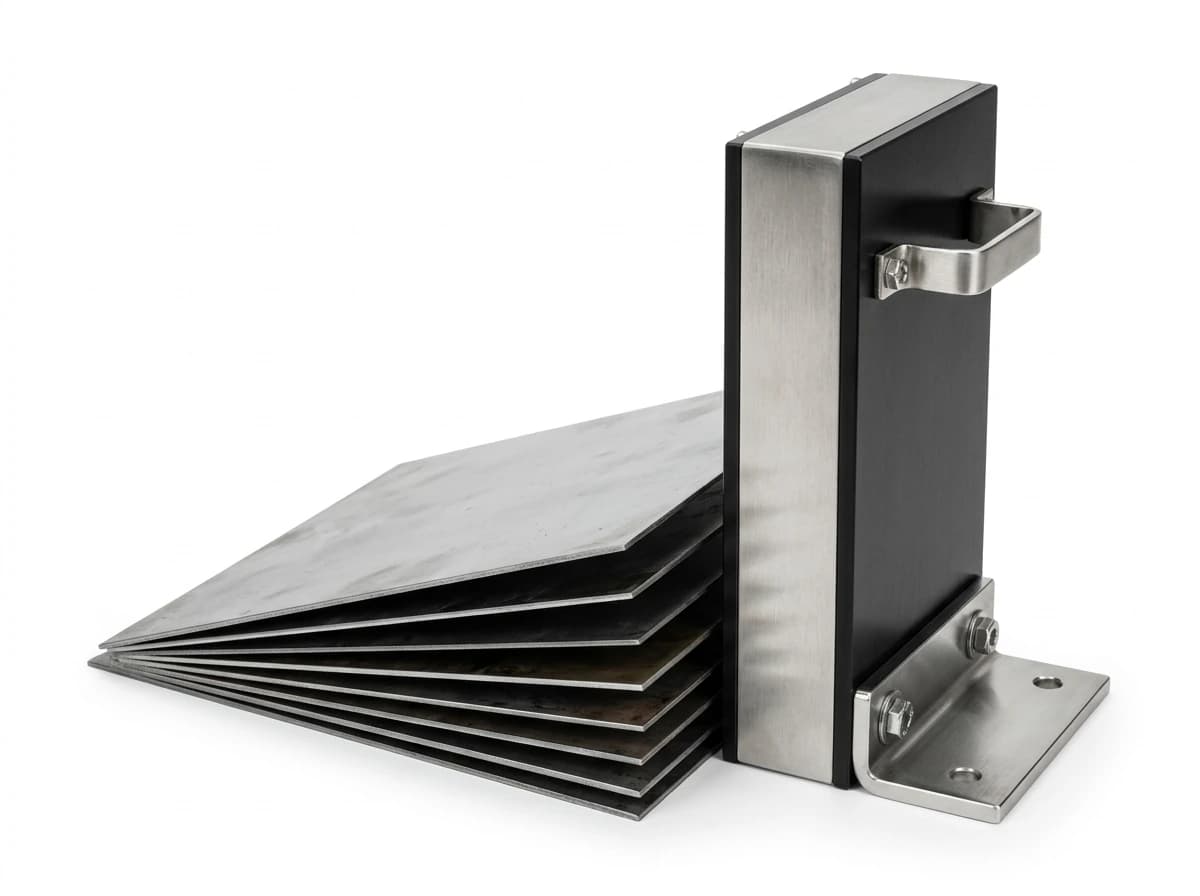
Magnetic Gripper vs Vacuum Gripper for Sheet Metal
Compare magnetic and vacuum grippers for sheet metal handling, including surface risks, validation tests, and RFQ data to send before buying.
Magnetic gripper vs vacuum gripper decisions move from theory to budget when a sheet metal handling cell starts missing pickups, marking parts, losing seal, or consuming too many vacuum cups. The right choice is not "magnet is always better" or "vacuum is always safer." It depends on material, surface condition, pickup area, cycle motion, stack behavior, release requirements, and how much validation the project can support.
Use this note when comparing gripper types for ferromagnetic sheet metal, blanks, plates, and stamped parts.
Start from material and failure mode, then decide whether to test magnetic, vacuum, or hybrid tooling first.
Quick Decision Table
| Evaluation point | Magnetic gripper fit | Vacuum gripper fit | What to verify |
|---|---|---|---|
| Workpiece material | Carbon steel and other ferromagnetic parts | Steel, aluminum, plastic, composites, cardboard, and mixed materials | Magnetic response and material grade |
| Pickup surface | Flat or repeatable contact area | Smooth enough to hold vacuum seal | Oil, coating, burrs, holes, roughness, and curvature |
| Perforations or holes | Often still viable if pole contact is enough | Often difficult when seal is interrupted | Real pickup area, not nominal part size |
| Energy behavior | Electro-permanent options can hold after switching | Vacuum requires air flow or stored vacuum strategy | Power-loss and air-loss risk model |
| Release behavior | Needs residual magnetism and double-sheet review | Usually straightforward if seal releases cleanly | Release time, placement tolerance, stacked sheets |
| Maintenance | No cups to replace, but pole faces and cables still matter | Cups, filters, hoses, generators, and seal surfaces need upkeep | Wear items and line-side replacement plan |
When Magnetic Grippers Usually Make More Sense
Test magnetic gripping when the workpiece is ferromagnetic and vacuum cups struggle to maintain a stable seal. Common examples include oily blanks, perforated steel, rough plate, parts with stamped features, or pickup zones where the available surface area is not friendly to cups.
Magnetic gripping can also simplify tooling when the cell handles multiple steel part shapes and the pickup area can be covered by a modular pole layout. For these projects, start from the sheet metal magnetic gripper and sheet metal handling pages before asking for a quotation.
The main caveat is that magnetic holding force is not a catalog number you can copy into a design review. It changes with material grade, contact area, air gap, thickness, surface condition, and robot motion. A steel part that looks flat in a drawing may still behave differently after oil, coating, burrs, or stamping deformation.
When Magnetic Grippers Are the Wrong Choice
Do not force a magnetic solution when the process conditions are against it. Vacuum, clamps, fingers, or hybrid tooling may fit when:
- The part is aluminum, plastic, composite, cardboard, or weakly magnetic stainless steel.
- The pickup zone has too little flat contact area for a stable magnetic pole layout.
- The surface gap changes heavily because of bends, welds, burrs, deep stamping features, or scale.
- The next process is sensitive to residual magnetism or attracted chips.
- The cell must mechanically capture the part through every possible motion and fault state.
- The production mix changes so widely that a single magnetic layout cannot cover the family.
Use this as a buying filter. If two or more of these conditions apply, request a sample test before budgeting for magnetic EOAT.
When Vacuum Grippers Still Win
Vacuum is still a strong option when the part is non-magnetic, when contact surfaces are predictable, or when the process needs a very clean release with minimal residual effect. Vacuum also fits mixed-material production where one EOAT must handle aluminum, plastic, cardboard, and steel.
For clean, smooth, lightweight panels with reliable seal area, vacuum may be easier to commission. It can also be preferable when the process has strict rules against magnetic fields or residual magnetism near the workpiece.
Do not replace vacuum with magnets just because the part is steel. Replace it only when the real failure mode is linked to seal reliability, surface variation, cup wear, part holes, air consumption, or tooling complexity.
Cost and Maintenance Factors Buyers Often Miss
The purchase price of the gripper is only part of the decision. Compare line-side maintenance, consumables, air use, downtime, and quality risk.
| Cost factor | Magnetic gripper buyer note | Vacuum gripper buyer note |
|---|---|---|
| Consumables | No vacuum cups, but pole faces, cables, and connectors still need inspection | Cups, filters, hoses, silencers, and generators may be recurring items |
| Energy system | Electro-permanent options may reduce continuous power needs | Compressed air can be expensive and capacity-limited in busy plants |
| Changeover | Modular pole layout can help with steel part families | Cup position changes may be easy when surfaces are predictable |
| Contamination | Scale and chips can collect on magnetic faces | Oil and dust can reduce seal quality and clog filters |
| Commissioning risk | Requires real holding and release validation | Requires seal stability and vacuum-loss strategy |
For procurement, a cheaper line-item quote may still cost more if it increases cup replacement, air usage, missed pickups, or release defects.
Failure Mode to First Test
Start with the problem the line is actually experiencing. That gives the first trial a measurable target.
| Current line problem | First test to run | Why |
|---|---|---|
| Vacuum cups miss oily blanks | Test magnetic pickup on oily and clean samples | Confirms whether seal loss is the real failure mode |
| Cups fail on perforated sheet | Compare magnetic pole contact against cup seal area | Holes may hurt vacuum more than magnetics if pole contact remains stable |
| Parts stick after magnetic release | Run residual magnetism and placement tolerance test | Confirms whether demagnetization or process tolerance is the blocker |
| Double-sheet pickup from stack | Test stack behavior for both technologies | Both magnetic and vacuum systems can need separators or process controls |
| Surface marking complaints | Inspect contact marks from cups, pole faces, and any mechanical locator | The best gripper is not acceptable if it creates quality defects |
| High compressed-air load | Compare vacuum air demand with electro-permanent or magnetic tooling concept | Energy cost may justify a tooling change even when both methods can pick |
This table keeps the supplier question concrete. Ask which gripper solves the documented failure mode with the least process risk.
Hybrid Tooling Can Be the Right Answer
Some sheet metal cells should not choose a single technology. A hybrid tool may combine magnetic modules with vacuum cups, mechanical stops, fingers, sensors, or spring-loaded locators when the part has mixed pickup zones, unstable stack behavior, or a critical release position.
Hybrid tooling adds complexity, but it can reduce risk when no single method covers the whole application. For OEM projects, describe the failure mode first: seal loss, slide, double-sheet pickup, release drift, marking, or cycle-time pressure. The tool design should solve that specific problem.
The Validation Tests We Recommend Before Selection
Before freezing the gripper type, test the actual part or a representative sample. A validation plan should include:
- Material response check: confirm the alloy and magnetic response, not just "steel" in a drawing.
- Pickup area mapping: mark the real contact zones available for magnetic poles or vacuum cups.
- Air-gap review: include coating, oil film, burrs, part curvature, and surface waviness.
- Motion test: simulate acceleration, deceleration, rotation, and emergency stop assumptions.
- Release test: measure whether the part releases cleanly and lands within placement tolerance.
- Double-sheet risk check: test stacked blanks or nested parts when depalletizing.
- Contamination review: check how dust, scale, chips, or oil affect both technologies.
If the project is still early, send photos, drawings, material notes, and target cycle data through Contact / RFQ. If the project is closer to release, include samples and acceptance criteria so the review can move beyond catalog assumptions.
Example Test Matrix
Use a small test matrix before choosing the technology:
| Test condition | Magnetic test | Vacuum test | Pass/fail question |
|---|---|---|---|
| Clean sample | Confirm baseline pickup and release | Confirm baseline seal and release | Does either method work under ideal conditions? |
| Oily or coated sample | Check air-gap impact and release | Check seal loss and cup contamination | Which method degrades faster? |
| Perforated or stamped area | Verify pole contact and holding margin | Verify seal path and cup placement | Is the real pickup zone usable? |
| Worst-case robot motion | Test slide, peel, and swing | Test vacuum loss under acceleration | Does the part stay controlled? |
| Stacked blank pickup | Check double-sheet risk | Check double-sheet or seal behavior | Can the cell pick one part reliably? |
| Repeated cycle run | Inspect heat, cable, face wear, and consistency | Inspect cup wear, hoses, filters, and consistency | What maintenance pattern appears? |
Even a short test can prevent the wrong EOAT decision because it reveals the actual failure mode instead of assuming it from drawings.
One-Day Comparison Trial Plan
For early projects, a one-day test can produce enough information to choose the next engineering direction.
Morning setup:
- Select clean, oily/coated, worst-flatness, and worst-thickness samples.
- Mark the intended pickup zone on each part.
- Record material, thickness, part weight, surface condition, and stack condition.
- Define pass/fail rules for pickup, motion, release, marking, and double-sheet risk.
Test sequence:
- Run static pickup for magnetic and vacuum concepts.
- Run orientation changes: horizontal, tilted, vertical, and rotation if relevant.
- Run a conservative motion profile, then the expected cycle motion if safe.
- Run release and placement checks.
- Inspect contact marks, remaining magnetism, cup wear, seal loss, chip attraction, or surface contamination.
End-of-day decision:
- If both methods pass, compare maintenance, energy, changeover, quote scope, and integration risk.
- If one method fails, document the failure mode and ask whether a design revision is realistic.
- If both methods fail, consider hybrid tooling, mechanical support, part separation, fixture changes, or a revised robot path.
A structured validation loop turns sample findings into engineering revisions before production tooling is frozen.
RFQ Data to Send for a Magnetic Gripper Review
For a magnetic gripper quotation, include:
- Workpiece material, grade, thickness, length, width, and weight.
- Surface condition: oil, coating, burrs, scale, holes, embossing, and flatness.
- Pickup orientation and whether the part is single, stacked, or nested.
- Robot or automation interface, payload limit, flange, available power, and signals.
- Cycle target, travel path, acceleration, placement tolerance, and release timing.
- Required safety factor and any drop-prevention or guarding assumptions.
- Quantity, project stage, destination country, and sample availability.
For custom tooling, also include mounting and cable preferences. The robot mounting interface and control cable connector customization pages explain what we normally review for OEM projects.
Buyer Decision Framework
Use these five questions before approving a gripper type:
- Is the workpiece material and pickup zone compatible with the technology?
- Which failure mode are we trying to fix: seal loss, cup wear, double sheet, release, marking, air use, or tooling complexity?
- What happens during power loss, air loss, emergency stop, and manual recovery?
- Can the supplier validate the real surface, stack, motion, and release conditions?
- Does the quote include the integration scope, or only the gripper module?
If the answer to question two is unclear, pause the purchase. A gripper should be selected to solve a defined process problem.
Procurement Comparison Sheet
Use a comparison sheet that includes technical scope, not only price:
| Compare item | Supplier A | Supplier B | Supplier C |
|---|---|---|---|
| Recommended technology | Magnetic, vacuum, hybrid, or mechanical | ||
| Assumed workpiece data | Material, thickness, surface, pickup zone | ||
| Validation included | Sample test, buyer-side test, or none | ||
| Integration scope | Tool only, EOAT, controller, adapter, cable, sensors | ||
| Risk notes | Release, double sheet, seal loss, marking, air use, safety | ||
| Prototype lead time | Days or weeks, with assumptions | ||
| Batch lead time | Days or weeks, with minimum order or annual demand assumption | ||
| Documents | Drawing, wiring note, inspection record, export documents | ||
| Revision policy | What changes are included after sample testing |
This sheet makes it harder for an incomplete quote to win only because it has the lowest first price.
Practical Recommendation
Use vacuum first when the material mix is broad or the surface is easy to seal. Test magnetic gripping when the project is focused on ferromagnetic parts and the real pain is seal instability, cup wear, perforated surfaces, oily blanks, or complex sheet metal pickup.
For most industrial projects, decide with a short validation loop, not a debate over generic gripper categories. Send the workpiece details to [email protected] or start a WhatsApp RFQ with your sample photos and robot model.
Example RFQ Message
We are comparing magnetic and vacuum grippers for sheet metal handling.
Part: [steel grade/material], [thickness], [dimensions], [weight].
Surface: [oil/coating/burrs/holes/stamping features].
Current issue: [seal loss / cup wear / missed pickup / double sheet / release drift].
Robot/cell: [robot model or automation type], cycle target, pickup orientation, motion notes.
Validation: we can provide [samples/photos/drawings] and need pass/fail criteria for pickup and release.
Please recommend whether magnetic, vacuum, or hybrid tooling should be tested first.
FAQ
Can magnetic grippers replace vacuum cups for every steel sheet?
No. Magnetic gripping still depends on material, thickness, contact area, air gap, surface condition, motion, and release behavior. Some steel sheets belong with vacuum, clamps, or hybrid tooling.
Are magnetic grippers safer than vacuum grippers?
Neither technology is automatically safer. Safety depends on the whole cell: holding margin, robot path, power or air-loss behavior, guarding, release confirmation, and validation with real workpieces.
What is the biggest magnetic gripper risk for sheet metal?
The common risks are overestimating holding force from catalog data, ignoring air gap, and not testing release behavior on coated, oily, or stacked parts.
What is the biggest vacuum gripper risk for sheet metal?
The common risks are seal loss, cup wear, poor pickup on holes or rough surfaces, and maintenance drift when filters, hoses, or cups degrade.
Author

Categories
More Posts
High-Temperature Magnetic Grippers: Sizing and Procurement for Hot Forging
High-temperature magnetic grippers sizing guide for hot forging: compare EPM safety, payload derating, duty cycles, cooling options, and RFQ inputs for buyers.
Magnetic Gripper Residual Magnetism and Demagnetization
Guide for engineers and buyers on why parts stick to magnetic grippers, how active demagnetization works, and how to define release acceptance criteria.
Safety Compliance and Fail-Safe Mechanisms in Magnetic EOAT: ISO 10218-2 and PL Buyer's Guide
A buyer's guide for procurement and engineering teams specifying fail-safe electro-permanent magnetic grippers against ISO 10218-2 and ISO 13849-1 expectations.