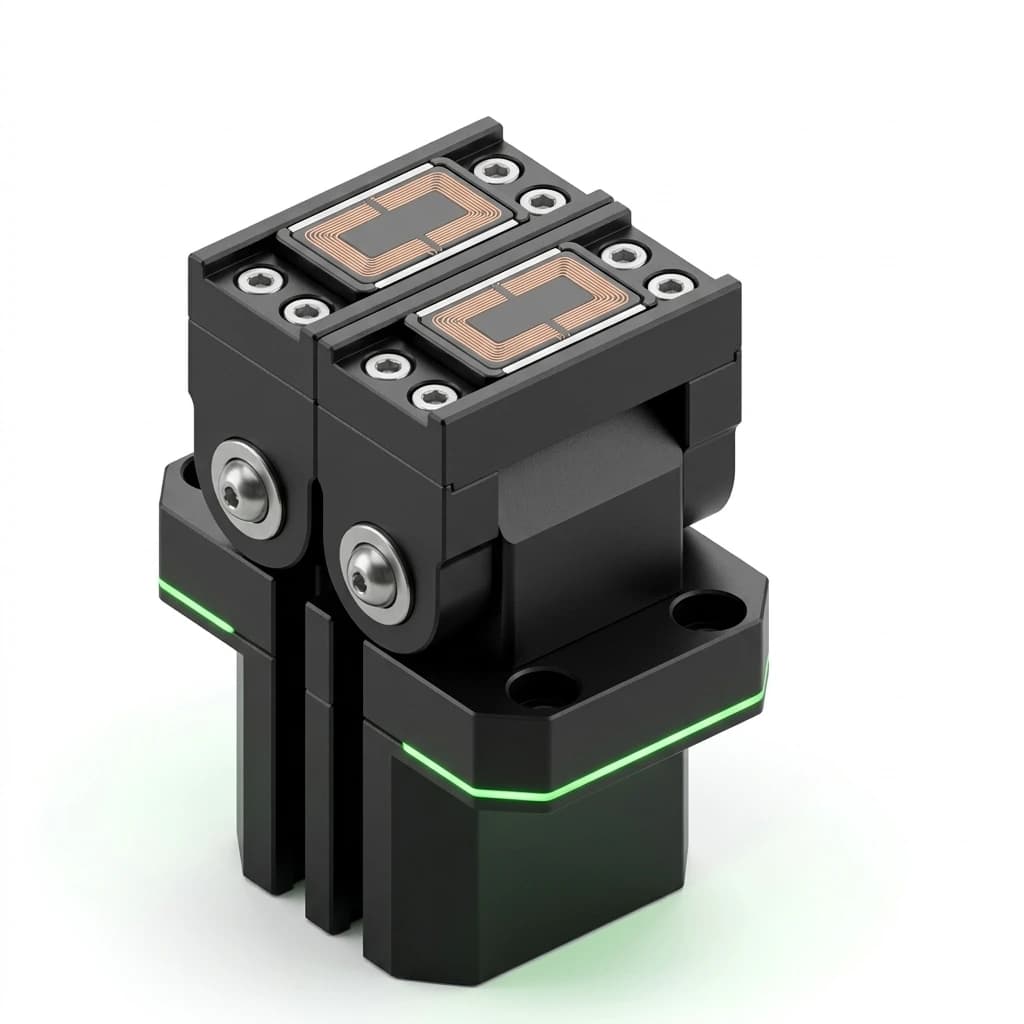
Cobot Gripper Selection for Magnetic EOAT
A practical cobot gripper selection guide for ferromagnetic workpieces, payload limits, mounting interfaces, and RFQ preparation.
Cobot gripper selection starts to break down when the workpiece is steel, the payload margin is tight, and the buyer wants a compact EOAT instead of a bulky pneumatic or mechanical tool. The magnetic module is only one part of the decision. The workpiece surface, payload stack, cable route, pole layout, and release behavior have to be checked together.
Use this as an RFQ preparation note before sending drawings, part photos, and robot data to a supplier.
Start With the Workpiece, Not the Robot Brand
The first question is not whether the gripper fits a cobot. The first question is whether the workpiece can be held magnetically in a controlled process.
Check these items before sizing:
| Workpiece factor | Why it matters for magnetic cobot gripping |
|---|---|
| Material grade | Stainless, aluminum, plastic, and coated assemblies may not respond like carbon steel. |
| Thickness | Very thin steel can reduce effective holding force and increase double-sheet risk. |
| Pickup area | The magnetic pole layout needs real contact area, not only nominal part dimensions. |
| Surface condition | Oil, coating, burrs, scale, and curvature create air gaps. |
| Part orientation | Horizontal pickup, vertical pickup, rotation, and acceleration create different load cases. |
| Release requirement | Residual magnetism and placement tolerance need validation. |
If these inputs are not clear, request sample validation before committing to tooling. The sample validation page explains how to define acceptance criteria before batch production.
When a Magnetic Cobot Gripper Is a Poor Fit
Magnetic gripping is not the default answer for every cobot project. Reject or sample-test the idea when the part is non-ferromagnetic, the available contact zone is too small, the surface gap changes too much, or the process cannot tolerate residual magnetism after release.
Thin, stacked, oily, curved, and loosely piled parts need extra review. These projects may still work, but do not approve tooling from catalog holding force alone.
| Red flag | Why it matters | Buyer action |
|---|---|---|
| Aluminum, plastic, or weakly magnetic stainless part | Magnetic force may be too low or inconsistent | Use vacuum, mechanical gripping, or sample test first |
| Very thin sheet | Holding force and double-sheet risk can change quickly | Send thickness range and stacked-sheet condition |
| Painted, galvanized, oily, or scaled surface | Air gap reduces real holding force | Test real samples, not clean lab coupons |
| Tight placement tolerance | Residual magnetism may affect release behavior | Define release acceptance before purchase |
| High acceleration or rotation | Dynamic load can exceed static assumptions | Share robot path and emergency-stop assumptions |
Cobot Payload Is the Full Tool, Not Just the Gripper
Many cobot projects fail at the payload review stage because the team only counts the magnetic module and part weight. The real payload stack includes:
- Magnetic gripper module or magnetic EOAT.
- Adapter plate and fasteners.
- Cable, connector, cable protection, and fittings.
- Workpiece weight.
- Tool center of gravity and moment arm.
- Any quick-change, bracket, sensor, or guarding hardware.
For a compact project, start from the cobot magnetic gripper page. For a more engineered cell, review magnetic EOAT because the interface and cable plan often matter as much as the magnetic face.
Review the complete tool-side mass and moment before approving a cobot gripper, not only the magnetic module weight.
Payload and Moment Data Buyers Should Prepare
A supplier can size the tool faster when the RFQ includes the load case, not only the part mass. Prepare these values before asking for final sizing:
| Input | What to provide | How it changes the design |
|---|---|---|
| Workpiece weight | Nominal and maximum weight, including oil or fixtures if relevant | Sets the minimum holding-force target |
| Pickup orientation | Horizontal lift, vertical lift, rotation, or tilted pickup | Changes slide, peel, and swing risk |
| Tool center of gravity | Approximate distance from robot flange to pickup face | Affects cobot payload and moment limits |
| Motion profile | Cycle time, acceleration, deceleration, and emergency stop assumptions | Determines dynamic load margin |
| Placement tolerance | Required release position and repeatability | Influences pole layout and demagnetization review |
If the cobot is already near its payload limit, do not approve the gripper until the adapter plate, cable protection, fasteners, sensors, and workpiece are included in the payload stack.
Mounting Interface Checklist
For a cobot RFQ, include the robot brand and model, but do not stop there. Send:
- Robot payload class and flange standard.
- Available tool I/O, voltage, and signal expectations.
- Maximum tool envelope and collision-sensitive zones.
- Preferred cable exit direction and dress-pack constraints.
- Whether a quick-change interface is required.
- Whether the gripper must be moved between multiple robots or fixtures.
The robot mounting interface page covers adapter plate and flange customization in more detail.
Magnetic Cobot Gripper vs Vacuum or Finger Gripper
Use a magnetic cobot gripper when the part is ferromagnetic and the pickup zone is stable enough for a pole layout. It can simplify tooling when vacuum cups lose seal or when finger grippers need complex geometry to capture the part.
Use vacuum when the part is non-magnetic, the surface seals reliably, or release cleanliness is the primary concern. Use finger or mechanical gripping when the process requires positive mechanical capture through every motion and risk case.
For sheet metal projects, compare this article with Magnetic Gripper vs Vacuum Gripper for Sheet Metal before deciding.
Common Failure Modes to Discuss Before Quotation
Cobot gripper projects tend to fail in predictable places. Put these on the review list before a quote is finalized:
- Insufficient real contact area: the drawing shows a large part, but holes, bends, ribs, or stamped features leave only a small pickup zone.
- Payload margin disappears after integration: adapter plates, quick changers, brackets, cable fittings, and sensors push the cobot over its usable limit.
- Release is not clean enough: the part lifts correctly but does not release within the placement tolerance.
- Cable routing becomes the weak point: the magnetic module works, but the cable bends too tightly or exits in the wrong direction for the robot path.
- One tool is expected to handle too many part families: a single pole layout may not cover all pickup zones with enough margin.
These issues are much cheaper to fix during RFQ review than after the EOAT is machined.
Customization Decisions to Freeze Before Prototype
Many RFQs ask for a "cobot gripper price" before the customization scope is clear. Those quotes are hard to compare. Before prototype approval, freeze the decisions that change engineering effort, machining, cable assembly, and validation.
| Customization item | Decision to make | Why it changes the project |
|---|---|---|
| Magnetic pole layout | Single face, multi-pole face, replaceable pole shoes, or part-family layout | Drives holding force, part coverage, release behavior, and machining |
| Adapter plate | Direct robot flange, quick-change interface, or custom bracket | Changes payload, center of gravity, and installation work |
| Cable exit direction | Side, rear, top, protected bend, or dress-pack route | Can decide whether the tool survives the robot path |
| Connector and signal | M8/M12, flying lead, terminal block, or customer-specific connector | Affects controller integration and maintenance replacement |
| Confirmation method | No sensor, pickup confirmation, release confirmation, or external cell sensor | Changes control logic and fault handling |
| Surface protection | Standard finish, anti-corrosion finish, replaceable wear face, or special marking control | Matters for oily, abrasive, humid, or export environments |
| Documentation package | Basic quote, drawing, wiring note, inspection record, or export-ready file set | Helps procurement, integrators, and maintenance teams compare suppliers |
If these points stay open, the first quote is only a rough concept. Approve a prototype configuration first, then use sample testing to decide what changes before batch production.
RFQ Checklist for a Magnetic Cobot Gripper
Send this information with the first inquiry:
- Cobot brand, model, payload, flange, and available tool I/O.
- Workpiece material, thickness, dimensions, weight, coating, oil, burrs, and pickup surface photos.
- Cycle target, motion profile, pickup orientation, and placement tolerance.
- Desired holding margin or internal safety factor.
- Release timing expectation and whether residual magnetism is a concern.
- Quantity, sample availability, destination country, and target delivery schedule.
- Customization needs for pole layout, adapter plate, cable, connector, or packaging.
This gives the supplier enough context for a first technical review. If the part is borderline, plan a sample validation loop before finalizing the design.
Acceptance Criteria for Sample Validation
Define pass/fail criteria before the supplier tests samples:
| Test area | Example acceptance criterion |
|---|---|
| Pickup reliability | 30 to 50 consecutive pickups without miss or slide under expected orientation |
| Release behavior | Part releases without manual assistance and stays within placement tolerance |
| Surface variation | Test passes on oily, coated, burr-affected, or worst-case samples if those appear in production |
| Stacked-part risk | No unintended second part is lifted under normal pickup conditions |
| Cable movement | Cable route does not bind, rub, or exceed bend limits through the robot path |
| Operator handling | Tool can be installed, cleaned, and inspected without special line-side workarounds |
Use your own internal limits for the exact numbers. Agree on the test before tooling is finalized.
Sample Test Record Template
Use a short test record so engineering, procurement, and the supplier are working from the same facts:
| Field | What to record |
|---|---|
| Sample ID | Part number, revision, material, coating, and condition |
| Pickup zone | Photo or marked drawing showing the actual magnetic contact area |
| Tool setup | Magnetic module, pole face, adapter plate, controller, and cable route |
| Robot setup | Robot model, payload setting, tool center, speed, acceleration, and path |
| Test cycles | Number of pickup/release cycles and any misses, slides, or double picks |
| Release result | Release time, final position, residual sticking, and manual intervention |
| Surface notes | Oil, burrs, scale, coating, curvature, and any contact marks |
| Decision | Pass, revise pole layout, revise mounting, revise cable, or reject magnetic pickup |
The record does not need to be long. It only needs enough detail to turn a failed test into a design change instead of another vague discussion.
A structured validation loop turns sample findings into engineering revisions before production tooling is frozen.
Recommended Selection Path
- Confirm the part is suitable for magnetic pickup.
- Estimate full EOAT mass, including adapter and cables.
- Check cobot payload and moment with the real tool center.
- Define pickup and release tests with representative parts.
- Freeze mounting, cable, connector, and quality-control notes after sample review.
If you already have drawings and robot data, send them to [email protected]. For a faster first pass, message WhatsApp +86 18857971991 with part photos, material, thickness, weight, and cobot model.
Example RFQ Message
Use this as a starting point for the first email:
We need a magnetic cobot gripper for a ferromagnetic workpiece.
Robot: [brand/model], payload [kg], flange [standard].
Part: [material], [thickness], [L x W], [weight], surface [oil/coating/burrs].
Pickup: [orientation], cycle target [seconds], placement tolerance [mm].
Concern: [release / double sheet / payload margin / cable route].
Quantity: [prototype quantity] now, estimated annual demand [quantity].
Attached: drawing, photos, pickup-zone notes, and robot path notes.
Internal Handoff Checklist for Buyers
Before sending the RFQ outside the company, align these internal owners:
- Manufacturing engineering: confirms workpiece variation, pickup orientation, cycle target, and acceptance criteria.
- Robot integrator: confirms payload, moment, flange, tool I/O, path, and collision zones.
- Maintenance: reviews cable route, connector choice, wear surfaces, cleaning access, and spare-part expectations.
- Quality: confirms marking limits, release tolerance, residual magnetism concern, and inspection records.
- Procurement: compares quote scope, prototype lead time, batch lead time, included documents, and revision cost.
This prevents a familiar handoff problem: engineering approves a working gripper concept, then installation or maintenance finds an unpriced integration detail.
Commercial Details That Change the Quote
For a China factory quote, these details often change cost or lead time:
| Commercial detail | Why it matters |
|---|---|
| Prototype quantity | One-off machining and small-batch cable assembly cost more per unit |
| Annual demand | Helps decide whether to optimize for machining cost, modular inventory, or custom fixtures |
| Destination country | Affects packaging, labeling, documents, and shipping method |
| Required documents | Drawings, inspection records, wiring notes, material notes, and export documents add preparation time |
| Sample availability | Faster validation if real parts can be tested before final design |
| Branding or OEM packaging | Changes label, packing, and documentation requirements |
FAQ
Is a magnetic cobot gripper plug-and-play?
Usually not without review. The magnetic module may be compact, but the adapter plate, payload, moment, cable route, tool I/O, and release sequence still need project-specific checks.
Can one cobot gripper handle several steel parts?
Sometimes. It depends on whether the parts share a reliable pickup zone and whether the pole layout can hold each part with enough margin.
What is the most common sizing mistake?
The most common mistake is checking payload by gripper mass only, then forgetting adapter plate weight, cable protection, fasteners, workpiece center of gravity, and motion loads.
Do you support custom cobot gripper kits?
Yes. We can review the magnetic module, pole layout, mounting plate, cable and connector, sample validation plan, and export packaging for OEM or integrator projects.
How much payload margin should a cobot gripper project keep?
There is no universal number because moment, acceleration, orientation, and safety policy matter. As a practical rule, treat the gripper, adapter, cable protection, sensors, and workpiece as one payload system and verify the final tool center with the cobot manufacturer's payload calculator or integrator review.
Author

Categories
More Posts
High-Temperature Magnetic Grippers: Sizing and Procurement for Hot Forging
High-temperature magnetic grippers sizing guide for hot forging: compare EPM safety, payload derating, duty cycles, cooling options, and RFQ inputs for buyers.
Magnetic Gripper Residual Magnetism and Demagnetization
Guide for engineers and buyers on why parts stick to magnetic grippers, how active demagnetization works, and how to define release acceptance criteria.
Safety Compliance and Fail-Safe Mechanisms in Magnetic EOAT: ISO 10218-2 and PL Buyer's Guide
A buyer's guide for procurement and engineering teams specifying fail-safe electro-permanent magnetic grippers against ISO 10218-2 and ISO 13849-1 expectations.